
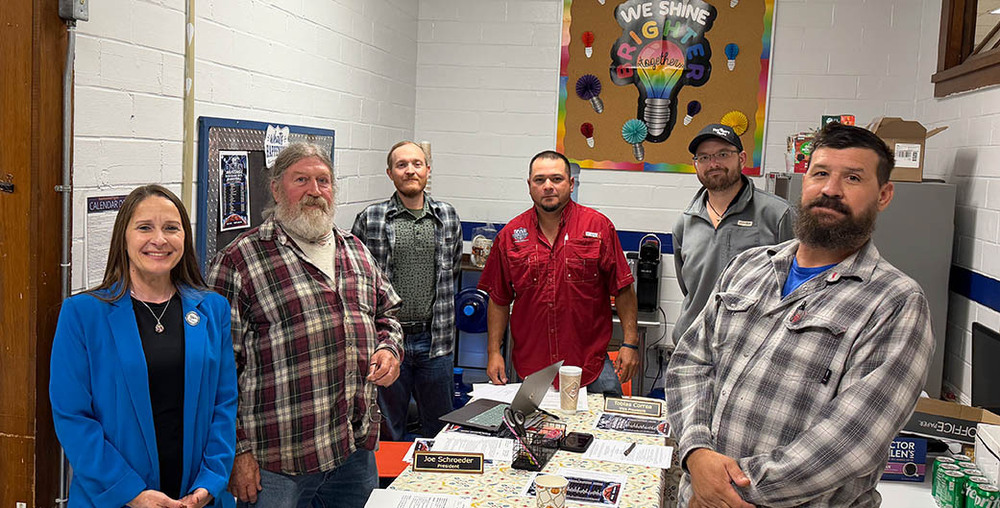
WTC President Laurie Sharp with the Olfen ISD Board of Trustees.
OLFEN—In small school districts, every student matters, and every educational opportunity can make a lasting difference. That message was at the heart of Western Texas College President Dr. Laurie Sharp's recent remarks to the Olfen Independent School District Board of Trustees. She spoke to the trustees during the time reserved for public comments.
Sharp's visit is part of her ongoing effort to meet with school district leaders throughout the 10-county service area that Western Texas College (WTC) serves. The visits help WTC learn about the needs of individual communities and identify ways the college can better serve rural students and families.
Drawing on her experience as a former classroom teacher, Sharp recognized the unique role educators play in smaller communities, where teachers and staff often take on multiple responsibilities while building close relationships with their students.
"In smaller school districts, educators often take on multiple responsibilities, and the relationships they build with students and families can make a lasting difference," Sharp told trustees.
One area of discussion was the opportunity to build on Olfen ISD's history of dual-credit participation at WTC.
During the past three academic years, 13 individual Olfen ISD students earned a combined 102 college credit hours through WTC. College records also show one associate degree completion during that period. While participation was recorded in the 2023–2024 and 2024–2025 academic years, no dual-credit enrollment was recorded for 2025–2026.
Rather than viewing those numbers solely as enrollment statistics, Sharp emphasized what they represent for individual students and families: an early start on college, increased confidence in academic abilities, and the potential to reduce the time and expense of earning a college credential.
The participation history also presents an opportunity for WTC and Olfen ISD to explore how dual-credit access might be renewed and expanded to benefit future students.
Sharp acknowledged that providing college-level courses in rural school districts can present challenges. She explained that WTC is currently reviewing faculty credentialing processes and exploring additional instructional approaches that could help expand access without compromising academic quality.
She also emphasized the value of face-to-face instruction, recognizing that many students benefit from having an instructor available to answer questions, offer encouragement, and provide direct academic support.
Beyond dual credit, Sharp discussed WTC's continued efforts to connect education with workforce opportunities. She pointed to the college's recently approved Vocational Nursing Prerequisite Certificate as one example of how WTC is developing pathways for students interested in high-demand careers.
Throughout her remarks, Sharp stressed that educational opportunities should reflect the needs of each community rather than follow the same model across every district.
"I do not want WTC to approach our partnerships with a one-size-fits-all mindset," Sharp said. "I want us to listen, understand what matters most to each district, and work together to identify opportunities that will make a meaningful difference."
For Olfen ISD, those conversations could include dual credit, career and technical education, college readiness, and educational pathways that prepare students for the transition to college or employment.
Sharp concluded by thanking Olfen ISD trustees, administrators, teachers, and staff for their commitment to students and reaffirming WTC's desire to remain an accessible and responsive educational partner.
Her visit reflects a broader commitment to ensuring that students in rural communities have access to meaningful educational opportunities, regardless of the size of their school district.
For Western Texas College, strengthening those opportunities begins with listening to the communities it serves and recognizing that the success of each student contributes to the future of West Texas.